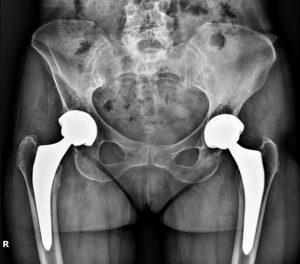
Several types of pathologies can affect the hip joint by damaging its normal biomechanics [1] (Fig. 1):
Osteoarthrosis (primary osteoarthritis): is the most common and affects people aged 50 years and older; it is a multifactorial disease (genetic, environmental and mechanical factors) due to progressive degeneration and wear and tear of articular cartilage.
Rheumatoid arthritis: caused by chronic auto-immune-based inflammation of the synovial lining of the joint; can lead to significant pain symptoms and stiffness.
Post-traumatic or secondary arthrosis: due to traumatic damage to the cartilage or vasculature of the femur produced by other pathologies (e.g., a previous fracture or the presence of congenital hip dysplasia…).
Pain gradually appears, as does joint stiffness. These two symptoms make it difficult to use the limb to perform normal daily actions such as walking, climbing or descending stairs until, in more advanced cases, hip flexion movement is made difficult.
The diagnosis is made following a specialist examination, during which a clinical examination is performed and instrumental investigations (mainly X-rays) are performed.
Hip replacement surgery (Fig. 2) is performed if the coxofemoral joint is worn or damaged [2].
Candidates for prosthetic surgery are people with acute pain that is not remissive to drug treatment and impediments in performing activities of daily living involving hip flexion, such as walking and sitting. In addition, fractures of the femur or pelvis that have little chance of healing can be successfully treated with prosthetic replacement. When drug treatments and ultrasound-guided hip infiltration do not achieve a satisfactory result and control of symptoms, the physician may recommend prosthetic hip replacement surgery.
The goal of hip replacement is to replace damaged joint components thus reducing pain. When performed with the most innovative minimally invasive techniques, damaged joint surfaces can be replaced with metal prosthetic implants without the use of cement (Fig. 3).
Recent studies [4] demonstrate that, regardless of the surgical approach used (Fig. 4), the functional results at 2 and 5 years are the same. This highlights how the key element to reduce complications and improve performance lies in the detailed pre-operative planning of the surgical intervention. Prof. Marcheggiani Muccioli has recently published a NEW BOOK entirely dedicated to the topic.
The surgical procedure takes about 1 1/2 hours on average and involves a surgical incision of about 10-15 cm. There are different access routes (anterior, lateral, and postero-lateral) that are used depending on the type of pathology and physical characteristics of the patient. (Fig. 4)
The hip replacement has an average life span of about 20 years and can be revised (Fig. 5) even several times if necessary (for example, when performed at a young age).
Surgery involves hospitalization, lasting an average of 5 days, at the surgeon’s discretion.
Spinal anesthesia is used in most cases.
Pain control drugs are administered for pain control and postoperatively anticoagulant drugs to prevent circulatory complications.
Rehabilitation begins the day after surgery, gradually resuming walking with the help of crutches. After hospitalization, the physiotherapy course will be continued at home or at a referral center. After 6-8 weeks, most patients are able to return to normal daily activities and sports without pain [3].
Hip Replacement: Professor Marcheggiani Muccioli’s Credentials
Professor Giulio Maria Marcheggiani Muccioli has distinguished himself in the field of orthopedics, beginning with a degree with honors in Medicine and Surgery from the University of Bologna in 2006, followed by a specialization with honors in Orthopedics and Traumatology at the Rizzoli Orthopedic Institute of Bologna and a PhD in Surgical Sciences.
Professor Marcheggiani Muccioli’s career includes the academic role of Associate Professor of Orthopedics at the Faculty of Medicine and Surgery of the University of Bologna, where he has focused on biomechanics and pathology of both lower and upper limbs.
He has expanded his expertise through international fellowships, including experiences in the United Kingdom, Japan, and the United States, establishing himself as an Orthopedic Surgeon with extensive practical experience, performing over 250 procedures per year.
Finally, Professor Marcheggiani Muccioli makes a significant annual contribution to the training of new generations of doctors through university teaching in multiple medical and surgical disciplines.
He is one of only 10 Italian surgeons selected in the past 20 years by the American Knee Society to participate in the prestigious John Insall Fellowship in Knee Prosthetic Surgery.
His prolific work in the field is reflected in over 250 scientific publications and a consistent presence in academic and conference settings, demonstrating his ongoing commitment to innovation in the treatment of knee and shoulder disorders, as well as in the advancement of minimally invasive surgical techniques and sports medicine.
Bibliography
- Soft tissues contribution to hip joint kinematics and biomechanics. Zaffagnini S, Signorelli C, Bonanzinga T, Lopomo N, Raggi F, Roberti Di Sarsina T, Grassi A, Marcheggiani Muccioli GM, Marcacci M. Hip Int. 2016 May 14;26 Suppl 1:23-7.
- Total Hip Arthroplasty: Past, Present, and Future. What Has Been Achieved?. Shon WY, Park BY, et al. Hip Pelvis. 2019 Dec;31(4):179-189.
- Requirements for Adequate Arthroplasty Care (Expert Opinions) Bleß HH. In: Bleß HH, Kip M, editors. White Paper on Joint Replacement: Status of Hip and Knee Arthroplasty Care in Germany [Internet]. Berlin (Germany): Springer; 2018. Chapter 6. Available from: https://www.ncbi.nlm.nih.gov/books/NBK546139/doi: 10.1007/978-3-662-55918-5_6.
- Implant Survival After Minimally Invasive Anterior or Anterolateral Vs. Conventional Posterior or Direct Lateral Approach: An Analysis of 21,860 Total Hip Arthroplasties from the Norwegian Arthroplasty Register (2008 to 2013). Knut Erik Mjaaland 1 , Svein Svenningsen, Anne Marie Fenstad, Leif I Havelin, Ove Furnes, Lars Nordsletten. J Bone Joint Surg Am. 2017 May 17;99(10):840-847.