
Dettagli tecnici e prospettive di recupero
Technical Details and Recovery Outlook Anterior cruciate ligament (ACL) reconstruction is an advanced surgical procedure required to restore knee stability and function following trauma or injury. This operation, essential for individuals with significant ACL damage, involves precise surgical techniques and highly detailed planning to ensure the best possible outcome.
The anterior cruciate ligament (ACL), along with the posterior cruciate ligament (PCL), forms the so-called “central pivot” (center of rotation) of the knee—a structure essential for maintaining joint stability by limiting the movement of the tibia relative to the femur (Fig. 1).

This topic is explored in the following sections::
Details about ACL reconstruction surgery
ACL reconstruction is defined by a series of precise technical steps, using cutting-edge medical technology and best surgical practices to ensure patient safety and surgical success. ACL injuries are among the most common ligamentous injuries in athletes, both amateur and professional.
The main cause is a significant knee twisting injury, frequently seen in sports such as soccer, skiing, volleyball, and basketball. It also occurs often in road trauma, particularly among motorcyclists (fall-related injuries).
Symptoms of a torn ACL vary significantly between patients. The typical presentation includes intense pain and significant swelling in the acute phase, and a feeling of giving way/instability with substantial functional limitations in the chronic phase.
Diagnosis is primarily based on clinical examination (performing specific laxity tests of the knee) and MRI to also assess any associated injuries to the menisci, collateral ligaments, or cartilage.
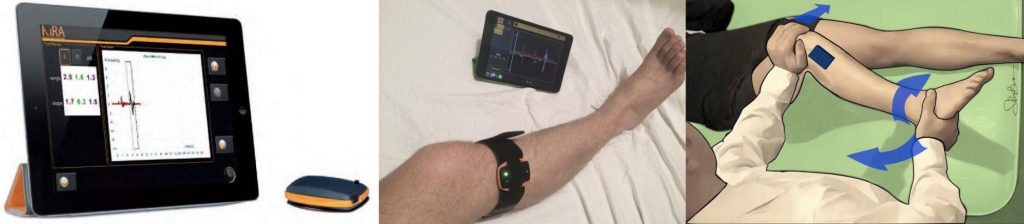
A quantitative assessment of knee laxity is also possible using increasingly advanced tools, one of which was developed at our institute (KIRA test, a non-invasive system that uses accelerometers and gyroscopes to measure knee laxity – Fig. 2) [1-2].
What happens if the ACL is not operated on?
Without surgical intervention, several scenarios may occur:
- Joint instability: Without ACL support, the knee becomes unstable and may give way during physical activity or even daily movements. This instability can lead to further injuries and long-term joint damage;
- Cartilage damage: Knee instability can lead to excessive friction between joint surfaces, causing cartilage damage. This can result in conditions like osteoarthritis, a progressive degeneration of the joint;
- Functional limitations: Without proper ACL support, knee movements may be impaired, limiting the ability to engage in physical and sports activities, affecting quality of life.
The decision between conservative or surgical treatment depends on multiple factors such as patient age, degree of instability, presence of associated injuries (meniscal, cartilage, or other ligament damage), and level of physical activity.
How long to wait before ACL surgery?
Timing for ACL reconstruction surgery depends on several factors, including:
- Degree of knee instability: If the knee is particularly unstable and symptoms are significant, surgery might be recommended as soon as possible to prevent further damage;
- Patient activity level: The patient’s activity level and lifestyle can influence timing. For example, athletes in high-impact sports may need prompt surgery to return to activity;
- Associated conditions: The presence of additional injuries or joint damage may require more urgent intervention.
In general, it is strongly advised not to delay surgery beyond 3-6 months to avoid further knee damage and support optimal recovery.
How long can you live with a torn ACL?
This depends on the severity of the injury and how well the patient can tolerate the symptoms. However, it’s important to understand that a torn ACL can compromise knee stability and function in the long term.
It is highly recommended to consult a specialized physician to evaluate the best treatment options and prevent additional joint damage.
How to know if you have a torn ACL?
A thorough medical evaluation is essential. Common signs and symptoms of a torn ACL include:
- Sudden knee pain and swelling after a traumatic event such as twisting or falling;
- Sensation of giving way or instability during movement;
- Difficulty walking or bearing weight on the affected knee;
- Limited mobility and joint stiffness;
- Reduced ability to participate in sports or physical activity due to pain and instability.
Only an experienced physician can confirm an ACL tear through a physical examination and imaging tests such as MRI. The use of tools to objectively measure knee joint laxity (Fig. 2) is helpful for diagnosing ambiguous cases or identifying recurrence.
Choosing the type of anesthesia for ACL surgery
ACL reconstruction can be performed under different types of anesthesia, depending on clinical needs and patient preferences.
- Regional anesthesia or nerve block: This allows the patient to remain awake while eliminating pain sensitivity in the surgical area. It is the most commonly used method and has fewer side effects;
- General anesthesia: Induces temporary unconsciousness, ensuring the patient feels no pain during surgery. It is usually recommended for uncooperative or pediatric patients.
La scelta dell’anestesia viene effettuata con un’attenta valutazione da parte dell’equipe medica, considerando lo stato di salute generale del paziente e la sua risposta agli anestetici.
The anesthesia choice is made by the medical team based on the patient’s overall health and response to anesthetics.
Duration and technique of ACL reconstruction surgery Modern ACL reconstruction is performed via minimally invasive arthroscopic techniques (“closed surgery”) (Fig. 3).
The procedure generally lasts about 1 hour and uses arthroscopy, a minimally invasive method that provides clear and direct visualization of the knee joint.

Fig. 3 Minimally invasive arthroscopic technique (“closed surgery”)
Knee arthroscopy: A small camera is inserted into the joint through a small incision. Connected to a video monitor, it allows the surgeon to precisely inspect ligaments and internal structures of the knee.
Depending on patient needs and medical history, either autologous tendons (harvested from the patient) or allograft tendons (from a deceased donor) may be used [3].
The technique developed by our team (OVER-THE-TOP + lateral tenodesis – Fig. 4) is based on decades of research using computer-assisted surgery (Fig. 5) [4] and has shown excellent results in professional athletes [5], with more than 20 years of proven clinical efficacy [6].
It is safe, as the additional external graft provides excellent rotational control of the knee [4], and it can be used in children and adolescents because it does not affect growth plates [7].

Fig. 4 OVER-THE-TOP + lateral tenodesis surgical technique: surgical diagram and post-operative X-ray control
ACL reconstruction: autograft and allograft
The tissue used to replace the damaged ACL may be:
- Autograft: from the same patient;
- Allograft: from a deceased donor.
Commonly used tissues for autografts include:
- Gracilis and semitendinosus tendons;
- Quadriceps tendon;
- Patellar tendon.

Fig. 5 Surgical navigation for computer-assisted ligament surgery
Key surgical steps
The main goals of ACL reconstruction are twofold:
- Stabilize the knee: Rebuilding the ACL restores knee stability, eliminating the sense of giving way that often follows ACL rupture;
- Prevent secondary damage: An unstable knee is at higher risk for cartilage damage and meniscal injuries during daily or sports activities.
ACL reconstruction helps reduce these risks and protects the joint from further harm.
Goals of ACL reconstruction
- Removal of the damaged ligament: Using specialized motorized tools, the torn ligament is carefully removed;
- Tissue harvesting for autograft: If an autograft is chosen, the required tendon is harvested through a 4-8 cm incision;
- Creation of bone tunnels: To house the new ligament, the surgeon prepares tunnels in the femur and tibia.
- The OVER-THE-TOP technique requires only one tibial tunnel, making the procedure less invasive;
- Fixation of the new ligament: The graft is firmly anchored to the bone using biodegradable or metallic screws or other devices (e.g., metal buttons), ensuring optimal stability during healing.
ACL surgery: recovery expectations
ACL reconstruction using arthroscopic techniques represents a significant advancement in treating knee injuries. This minimally invasive approach, paired with tailored anesthesia and the use of autologous or allograft tissue, ensures optimal surgical outcomes.
With proper rehabilitation, patients can expect full recovery of knee function and stability, allowing them to return to daily activities and sports with renewed confidence.
Average hospital stay is 1-2 days. Rehabilitation starts as early as the second day post-surgery and typically continues for 4-6 months. Sedentary work can resume within 7-10 days, while physically demanding jobs may require 2-3 months. Sports activities are generally allowed after about 5-6 months.
Prof. Giulio Maria Marcheggiani Muccioli has distinguished himself in orthopedics, graduating with honors in Medicine and Surgery at the University of Bologna in 2006, specializing with honors in Orthopedics and Traumatology at the Rizzoli Orthopedic Institute, and earning a PhD in Surgical Sciences.
He is an Associate Professor of Orthopedics at the University of Bologna’s Faculty of Medicine and Surgery, with a focus on biomechanics and lower/upper limb pathology.
He expanded his expertise through international fellowships in the UK, Japan, and the USA, establishing himself as an orthopedic surgeon with extensive experience, performing over 250 surgeries annually.
He plays a key role in training new generations of doctors through academic teaching in various medical and surgical disciplines.
He is one of only ten Italian surgeons selected in the last 20 years by the American Knee Society for the prestigious John Insall Knee Surgery Fellowship. His contributions include over 250 scientific publications and constant academic and conference involvement, demonstrating his commitment to advancing minimally invasive techniques, sports medicine, and innovations in knee and shoulder treatment.
Bibliography
- Innovative technology for knee laxity evaluation: clinical applicability and reliability of inertial sensors for quantitative analysis of the pivot-shift test. Zaffagnini S, Lopomo N, Signorelli C, Marcheggiani Muccioli GM, et al. Clin Sports Med. 2013 Jan;32(1):61-70.
- In-vivo pivot-shift test measured with inertial sensors correlates with the IKDC grade. Marcheggiani Muccioli GM, Signorelli C, Grassi A, et al Journal of ISAKOS: Joint Disorders & Orthopaedic Sports Medicine 2018;3:89-93.
- Arthroscopic intra- and extra-articular anterior cruciate ligament reconstruction with gracilis and semitendinosus tendons: a review. Marcacci M, Zaffagnini S, Marcheggiani Muccioli GM, et al. Curr Rev Musculoskelet Med. 2011 Jun;4(2):73-7.
- Anatomic and nonanatomic double-bundle anterior cruciate ligament reconstruction: an in vivo kinematic analysis. Zaffagnini S, Marcheggiani Muccioli GM, Signorelli C, et al. Am J Sports Med. 2014 Mar;42(3):708-15.
- Return to sport after anterior cruciate ligament reconstruction in professional soccer players. Zaffagnini S, Grassi A, Marcheggiani Muccioli GM, et al. Knee. 2014 Jun;21(3):731-5.
- Over-the-top ACL Reconstruction Plus Extra-articular Lateral Tenodesis With Hamstring Tendon Grafts: Prospective Evaluation With 20-Year Minimum Follow-up. Zaffagnini S, Marcheggiani Muccioli GM, Grassi A, et al. Am J Sports Med. 2017 Dec;45(14):3233-3242.
- Anterior cruciate ligament reconstruction with an all-epiphyseal “over-the-top” technique is safe and shows low rate of failure in skeletally immature athletes. Roberti di Sarsina T, Macchiarola L, …, Marcheggiani Muccioli GM, Zaffagnini S. Knee Surg Sports Traumatol Arthrosc. 2019 Feb;27(2):498-506.
Book online
