
A Step Toward Restoring Mobility and Reducing Pain
Knee replacement represents a cutting-edge medical solution, essential for addressing degenerative knee conditions affecting a large global population. Degenerative knee diseases stem from inflammatory processes that lead to the destruction of anatomical components and the remodeling of the knee joint surfaces. (Fig. 1-2)
We explore the topic in the following sections:
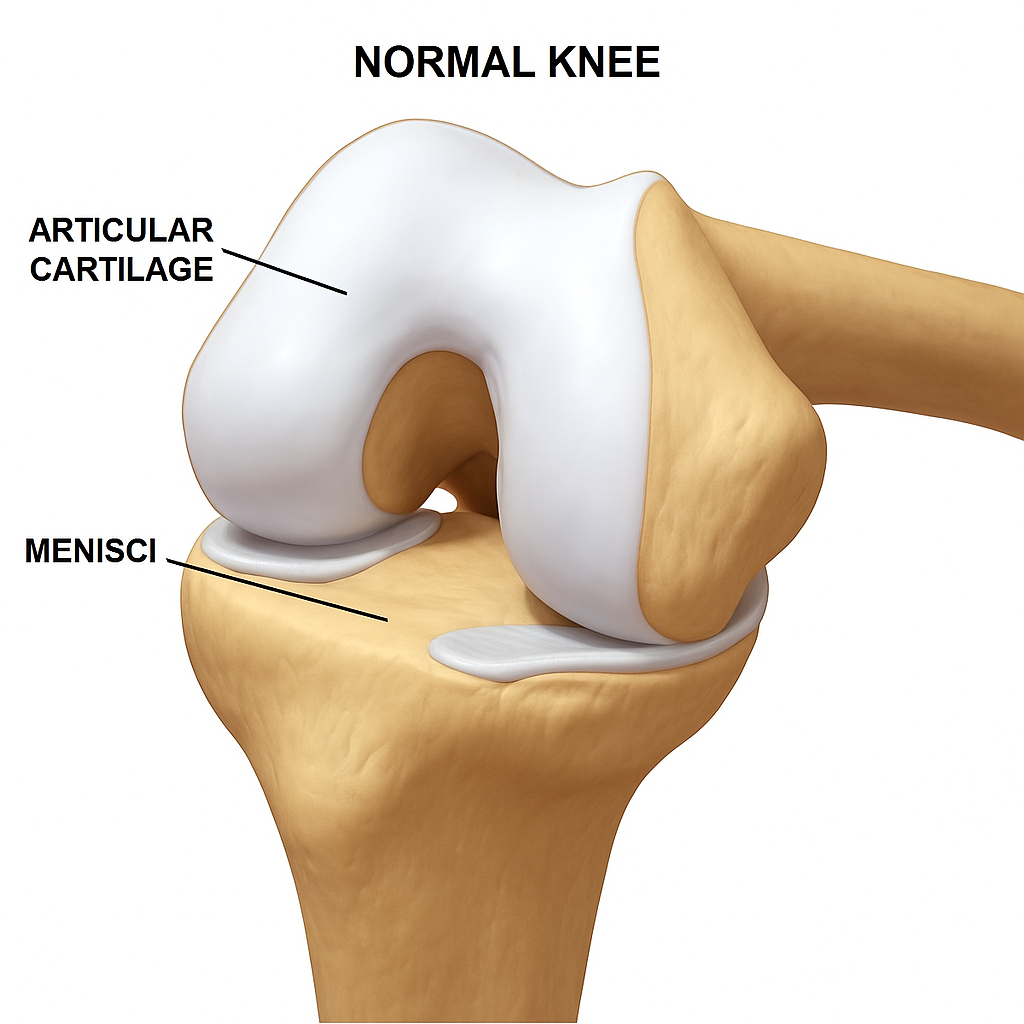
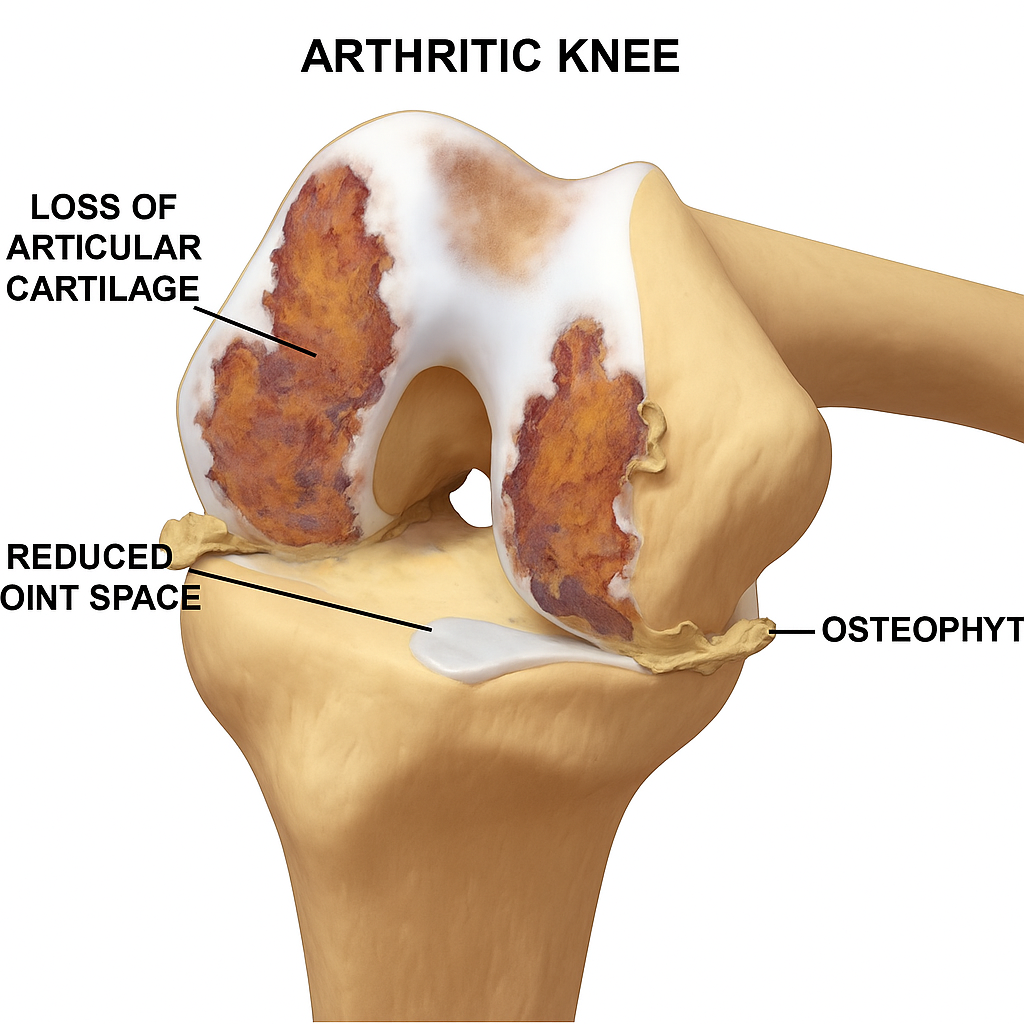
Knee replacement aims to restore lost mobility and eliminate chronic pain, significantly improving patients’ quality of life.
What is a Knee Replacement?
A knee replacement involves artificial components, mainly made from metal alloys like titanium, that are inserted into the joint to replace damaged parts. The goal is to allow patients to resume daily activities without pain, ensuring natural and smooth joint movement.
Knee joint disorders affect a large segment of the population, especially individuals over 60, but also younger patients suffering from trauma or those performing physically demanding jobs.
The increasing incidence of these conditions highlights the importance of knee replacements as a fundamental therapeutic tool.
When Is a Knee Replacement Necessary?
The decision to implant a knee prosthesis results from a thorough evaluation, intended for patients with advanced degenerative conditions that significantly impact their quality of life. These conditions are marked by chronic pain, limited mobility, and significant restrictions in daily activities.
As one of the most stressed joints in the body, the knee plays a vital role in movement, walking, and weight-bearing. Damage due to trauma, degenerative diseases, or injuries can severely impair its function, making a prosthesis necessary to regain mobility and relieve pain.
Conditions That May Require a Knee Replacement
When is it time to get a knee replacement? Several conditions may indicate the need for a knee prosthesis, including:
- Osteoarthritis: the most common cause of knee deterioration, characterized by the progressive erosion of articular cartilage, leading to pain, stiffness, and mobility loss (Fig. 2).
- Rheumatoid arthritis: an autoimmune disease that attacks the joints, including the knee, causing inflammation, pain, and long-term cartilage and bone damage.
- Severe trauma: major knee injuries, such as fractures or ligament and meniscal damage, compromising stability and function.
- Meniscal tears: damage to the menisci that can cause pain, swelling, and movement limitations. In severe cases, replacement may be considered.
- Avascular necrosis: loss of blood flow to the femoral bone leading to bone tissue death and compromised knee function.
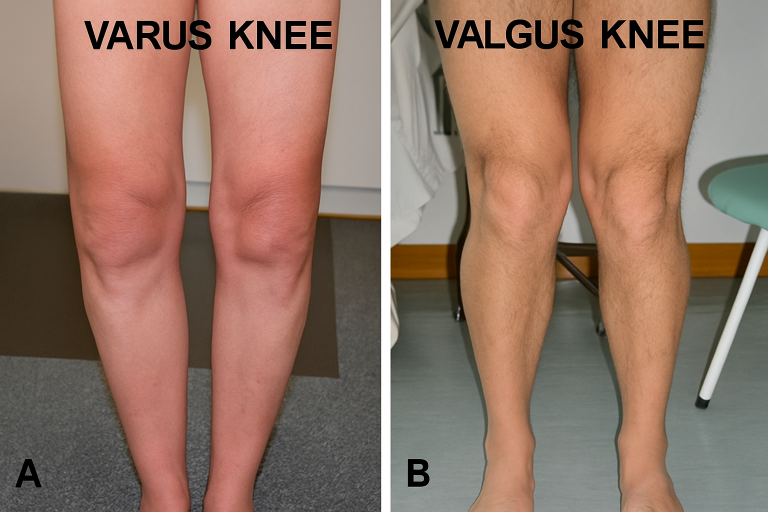
- Severe deformities: conditions such as significant varus or valgus misalignments can affect knee alignment and function (Fig. 3).
Knee Replacement: How Does the Surgery Work?
Knee replacement surgery involves advanced surgical techniques and close cooperation between the anesthesiology and orthopedic teams. Arthroplasty consists of several steps aimed at removing and replacing damaged joint parts with artificial components.
Steps of Knee Replacement Surgery
- Bone preparation: worn cartilage and damaged bone are removed to create a stable surface for the prosthesis.
- Component placement: metal components may be fixed to:
- Femur: the end of the femur is covered with a metal component.
- Tibia: the top of the tibia is also fitted with a metal component.
- Patella: depending on necessity, the back of the patella may also be replaced. This decision depends on intraoperative assessment.
- Polyethylene insert: placed between metal components to function as artificial cartilage and ensure proper movement
Types of Knee Prostheses
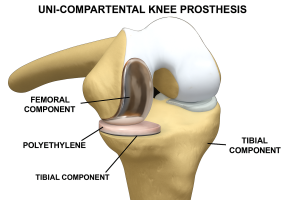
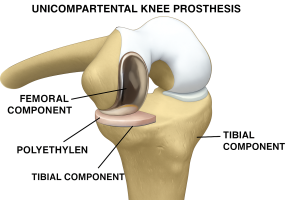
- Unicompartmental prosthesis: replaces only one part of the joint, preserving cruciate ligaments. Indicated for localized damage (Fig. 4).
- Bicompartmental prosthesis: replaces two components, usually the femur and tibia; considered a form of total knee replacement (Fig. 5–6)

- Protesi tricompartimentale: replaces the entire joint complex, including the patella.
Post-Operative Recovery: How Soon Can You Walk Again?
Post-operative recovery is crucial for the success of the procedure and for improving quality of life. Recovery time varies depending on the prosthesis type and the patient’s individual characteristics and healing ability.
- Unicompartmental prosthesis: usually allows faster recovery. Patients may start walking with crutches the day after surgery. Many resume daily activities and light exercise within a month, based on medical advice. Minimally invasive unicompartmental implants can even allow return to non-contact sports. [7]
- Total knee prosthesis:generally involves a longer recovery period. Most patients resume daily activities within 45 days. Physiotherapy and targeted exercises are vital for restoring muscle strength and range of motion. Rehabilitation begins the day after surgery, aiming for a return to normal life in about 45–60 days.
The type of prosthesis [3–5] and surgical technique [6] depend on clinical conditions and the extent of joint damage. A thorough pre-operative consultation is essential to determine the most suitable solution for the best outcome and optimal recovery.
At the Rizzoli Orthopedic Institute, I have conducted clinical research in the field of knee prosthetics for over 10 years. [2,6–7]
We recently introduced cutting-edge technology allowing us to evaluate the pros and cons of different prosthesis models through in-vivo testing (Dynamic RSA). [1, 3–5]
There is no strict age or weight limit for knee replacement, though it’s important to note that implants don’t last forever (on average 15–20 years), and excessive body weight may shorten their lifespan. However, knee arthroplasty revisions can be performed up to 3–4 times by replacing the old prosthesis with a more stable one.
Realistic Expectations from Total Knee Replacement
It’s vital to fully understand the procedure, including risks and complications. Although over 90% of patients report significant improvement, the surgery won’t restore the joint beyond its pre-arthritic state.
Strenuous activity or excessive weight can speed up implant wear, possibly requiring revision surgery. High-impact activities are discouraged; low-impact ones like walking, swimming, and cycling are recommended.
Potential Complications
While rare, serious complications such as infections or blood clots may occur. Infections might require antibiotics or additional procedures, and clots are managed with standard post-op care.
Other risks include implant wear, persistent pain in a small percentage of patients, nerve or blood vessel injury, and rare allergic reactions to materials.
The decision to undergo knee replacement should follow a thorough discussion with an orthopedic specialist, carefully weighing expected benefits and potential risks.
Innovative Surgical Techniques and Technologies
Knee replacement is one of the most common orthopedic surgeries, with continuous advances significantly improving outcomes, patient satisfaction, and implant longevity. Innovative methods aim to personalize surgery based on patient needs and preserve natural joint anatomy.
- Kinematic alignment: this technique respects the knee’s original anatomy, avoiding forced alignment. It’s ideal for patients with naturally misaligned knees and offers better tolerance and longevity;
- Customized knee prostheses: using radiographic imaging, this technology allows for a tailored surgical plan, reducing complications, speeding recovery, and potentially lowering costs;
- Robotic surgery: robotic systems improve precision in bone cuts and implant positioning, nearly eliminating human error. Pre-op planning software ensures unmatched accuracy, shorter hospital stays, and longer implant lifespan;
- Augmented reality: one of the most revolutionary tools, AR enables the surgeon to view clinical data and guide images directly in the surgical field without looking away. 3D joint models help optimize implant positioning for each patient’s anatomy
Knee Replacement Surgery: Prof. Marcheggiani Muccioli’s Profile
Prof. Giulio Maria Marcheggiani Muccioli has distinguished himself in orthopedics, graduating with honors in Medicine and Surgery at the University of Bologna in 2006, specializing with honors in Orthopedics and Traumatology at the Rizzoli Orthopedic Institute, and earning a PhD in Surgical Sciences.
He is an Associate Professor of Orthopedics at the University of Bologna’s Faculty of Medicine and Surgery, with a focus on biomechanics and lower/upper limb pathology.
He expanded his expertise through international fellowships in the UK, Japan, and the USA, establishing himself as an orthopedic surgeon with extensive experience, performing over 250 surgeries annually.
He plays a key role in training new generations of doctors through academic teaching in various medical and surgical disciplines.
He is one of only ten Italian surgeons selected in the last 20 years by the American Knee Society for the prestigious John Insall Knee Surgery Fellowship. His contributions include over 250 scientific publications and constant academic and conference involvement, demonstrating his commitment to advancing minimally invasive techniques, sports medicine, and innovations in knee and shoulder treatment.
Bibliography
- Total knee replacement: intraoperative and postoperative kinematic assessment. Bontempi M, Cardinale U, Bragonzoni L, Macchiarola L, Grassi A, Signorelli C, Marcheggiani Muccioli GM, Zaffagnini S. Acta Biomed. 2017 Jun 7;88(2S):32-37.
- Minimally invasive unicompartmental knee replacement: retrospective clinical and radiographic evaluation of 83 patients. Bruni D, Iacono F, Russo A, Zaffagnini S, Marcheggiani Muccioli GM, et al. Knee Surg Sports Traumatol Arthrosc. 2010 Jun;18(6):710-7.
- New design total knee arthroplasty shows medial pivoting movement under weight-bearing conditions. Bragonzoni L, Marcheggiani Muccioli GM, Bontempi M, et al. Knee Surg Sports Traumatol Arthrosc. 2019 Apr;27(4):1049-1056.
- J-curve design total knee arthroplasty: the posterior stabilized shows wider medial pivot compared to the cruciate retaining during chair raising. Bontempi M, Roberti di Sarsina T, Marcheggiani Muccioli GM, et al. Knee Surg Sports Traumatol Arthrosc. 2019 Aug 3. doi: 10.1007/s00167-019-05645-6.
- Multi-radius posterior-stabilized mobile-bearing total knee arthroplasty partially produces in-vivo medial pivot during activity of daily living and high demanding motor task. Marcheggiani Muccioli GM, Pizza N, Di Paolo S, et al. Knee Surg Sports Traumatol Arthrosc. 2020 Jan 18. doi: 10.1007/s00167-020-05846-4.
- Two different posterior-stabilized mobile-bearing TKA designs: navigator evaluation of intraoperative kinematic differences. Marcheggiani Muccioli GM, Fratini S, Roberti Di Sarsina T, et al. Musculoskelet Surg. 2020 Jan 28. doi: 10.1007/s12306-020-00643-1.
- Return to Sports after Unicompartmental Knee Arthroplasty: Reality or Utopia? A 48-Month Follow-Up Prospective Study. Lo Presti M, Costa GG, Cialdella S…, Marcheggiani Muccioli GM, Zaffagnini S. J Knee Surg. 2019 Feb;32(2):186-191.
Book online
