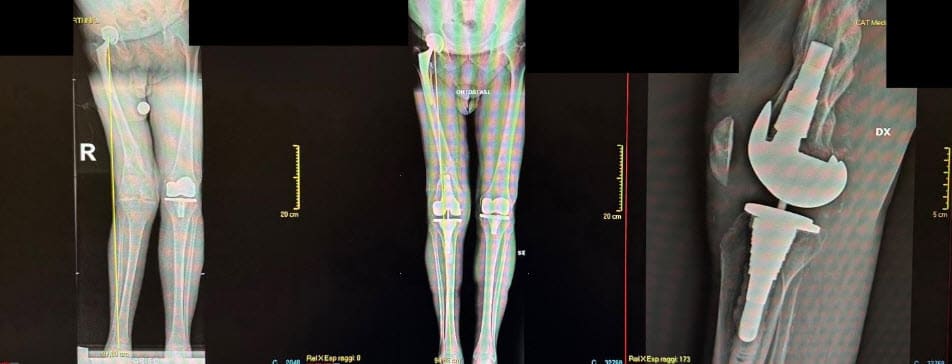
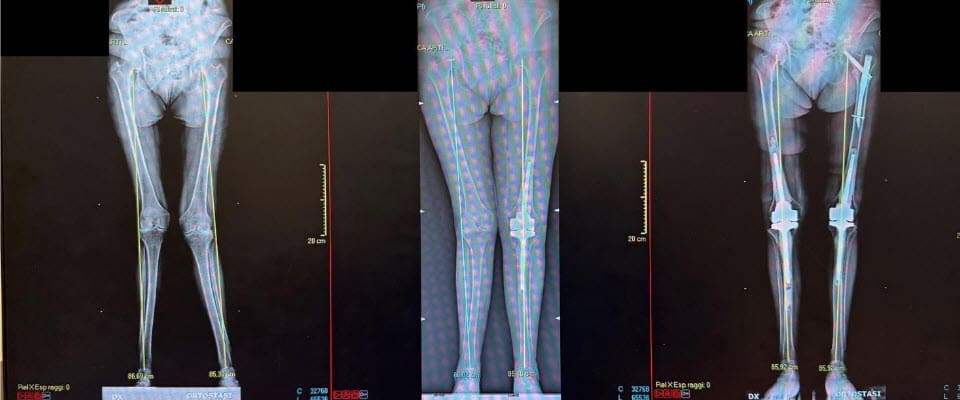
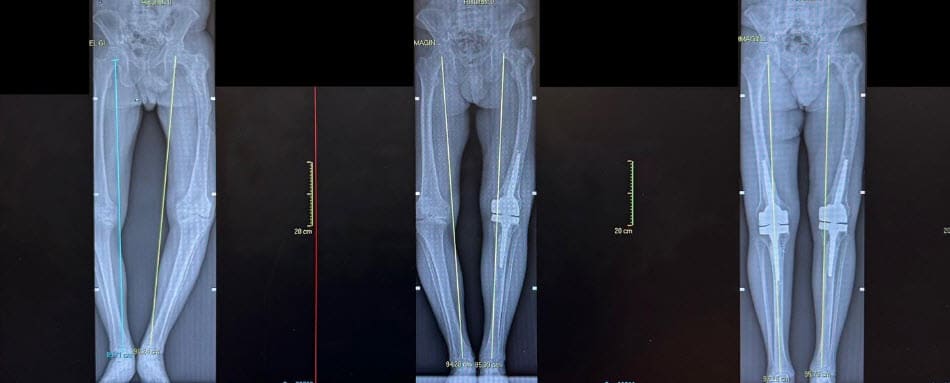
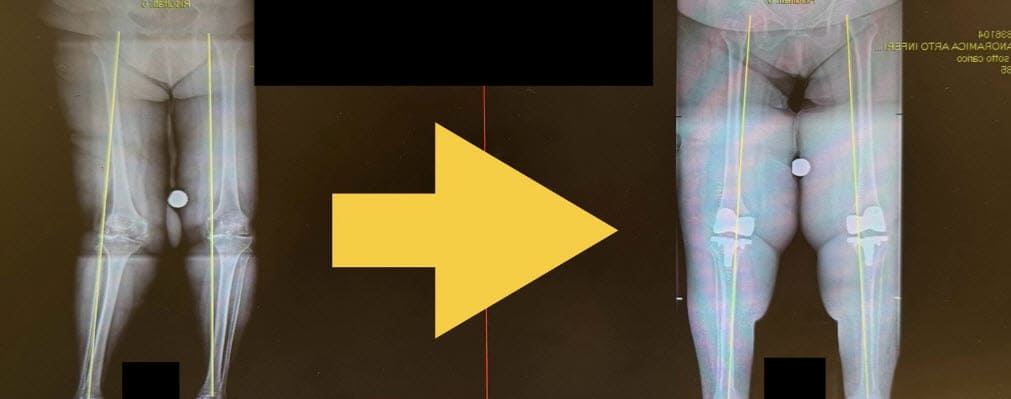
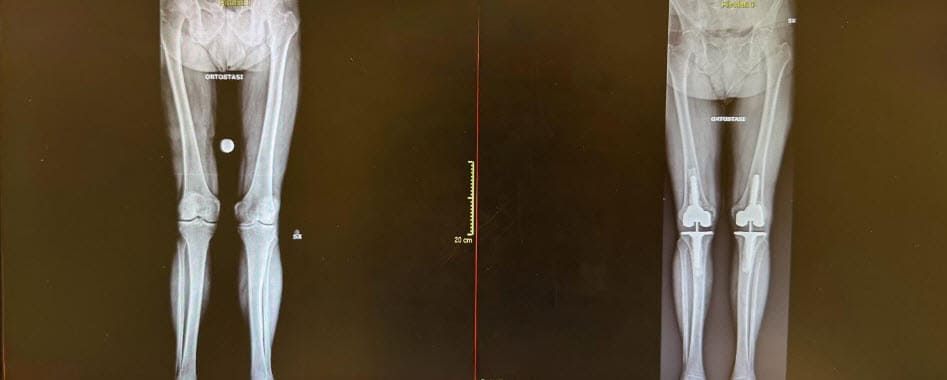
There are some types of patients who are candidates for a primary total knee replacement and who present complex mechanical deformities of one or both lower limbs. This makes knee arthroplasty significantly more challenging. These are no longer routine procedures, but specific cases that require thorough preoperative planning. For these patients, it is sometimes necessary to operate on both knees during the same surgical session (Bilateral Total Knee Replacement). This is to prevent the persistence of an uncorrected deformity in the non-operated limb from causing early mechanical failure (loosening) of the prosthesis (Fig. 1 and Fig. 2). [1] In other cases, only one limb is replaced at a time, but revision-type implants are required: semi-constrained prostheses (Fig. 3) or rotating-hinge prostheses (Fig. 4 and Fig. 5). Very often, the contralateral limb also requires replacement, but in a second stage (Fig. 4 and Fig. 5). Performing a bilateral primary knee arthroplasty using a revision-type implant is not recommended, as the invasiveness of the procedure could place the patient at serious risk (possible complications such as anemia, infection, deep vein thrombosis). [2]

About complex knee replacements

The term complex knee replacements refers to procedures in which joint or skeletal deformities, associated conditions, or the patient’s overall health make surgical execution and planning particularly challenging. The most common situations include:
  • severe axial deformities, such as pronounced valgus or varus knees;
  • outcomes of previous fractures or surgeries that alter femoral or tibial anatomy;
  • advanced osteoporosis or rheumatoid arthritis;
  • presence of prostheses in other joints (contralateral hip or knee);
  • elderly patients or obese individuals with ligamentous laxity or poor bone quality.
In these cases, complex knee replacement requires a multidisciplinary preoperative assessment and careful planning using advanced imaging and digital simulations. The goal is to achieve correct mechanical alignment, restore joint stability, and reduce the risk of complications.

Types of implants for complex knee replacements

Depending on the severity of the deformity and the condition of the tissues, the surgeon may resort to more complex implants compared to standard prostheses:
  • Semi-constrained prostheses, indicated when ligamentous stability is partially compromised but a certain degree of natural movement can still be preserved;
  • Rotating-hinge prostheses, used in cases of severe instability or deformity, when the ligaments no longer provide any mechanical control of the joint.
The choice of implant type is crucial for the success of the procedure: an implant that is not sufficiently constrained may lead to early loosening, while one that is too constrained increases stress on the components and surrounding bone.

Advanced preoperative planning techniques

The preoperative phase is essential in cases of complex knee replacements. In addition to clinical evaluation, the following can be used:
  • Full weight-bearing radiographs (hip-to-ankle) to assess extra-articular deformities and plan the correct mechanical alignment.
  • Digital templating to estimate component size and positioning, with accuracy exceeding 90% in experienced centers.
  • 3D printing and anatomical models useful for reconstructing complex deformities or significant bone loss.
  • Patient-specific cutting guides (patient-specific instrumentation) derived from CT scans and 3D modeling, reducing alignment error to less than one degree.
Navigation and robotic systems (such as ROSA, MAKO, NAVIO) are increasingly widespread, providing real-time intraoperative control over alignment, thickness, and rotational parameters.
Ginocchia difficili
Fig. 1 Bilateral knee replacement in a patient with wind-swept deformity (one knee in varus and the other in valgus).
ginocchia difficili
Fig. 2 Bilateral knee replacement for bilateral valgus knees in an obese patient (weight >115 kg).

Types of implants for complex knee replacements

Depending on the severity of the deformity and the condition of the tissues, the surgeon may need to use more complex implants compared to standard prostheses:
  • Semi-constrained prostheses, indicated when ligamentous stability is partially compromised but a certain degree of natural joint motion can still be maintained;
  • Rotating-hinge prostheses, used in cases of severe instability or deformity, when the ligaments no longer provide any mechanical control of the joint.
The choice of implant type is essential for the success of the surgery: an implant that is not sufficiently constrained may lead to early loosening, while one that is too constrained increases stress on the components and surrounding bone.

Surgical principles and intraoperative strategies

Surgical procedures involving complex knee replacements often require more extensive operative techniques:
  • Extended surgical approaches to ensure proper exposure of the joint without compromising the soft tissues.
  • Management of extra-articular deformities, assessing whether to correct them with concomitant osteotomies or adapt the prosthetic procedure accordingly.
  • Precise ligament balancing, with intraoperative decisions to switch to more constrained implants if stability is not adequately achieved.
  • Treatment of bone defects using cones, sleeves, or metal augments to restore metaphyseal stability.
  • Control of rotational alignment to avoid femorotibial mismatches and improve postoperative kinematics.
The surgeon’s experience and the availability of modular instrumentation are essential to tailor the intraoperative strategy to each individual case.

Bilateral management and timing of surgery

In cases of complex bilateral knee replacements, the decision to operate on both joints during the same surgical session or in two separate stages depends on the patient’s health status, the degree of deformity, and the overall surgical risk. Staged treatment allows for a more gradual recovery and a reduction in complications, especially in elderly or fragile patients.

Outcomes and postoperative recovery

Even in cases of complex knee replacements, functional outcomes can be excellent when the procedure is performed by a team experienced in complex orthopedic surgery. Rehabilitation plays a crucial role: it must be personalized and progressive, with careful monitoring of muscle strength, range of motion, and knee stability. Full recovery may take several months, but quality of life significantly improves as early as the first few weeks after surgery.
ginocchia difficili
Fig. 3 Knee replacement for severe valgus deformity following distal femoral fracture with obliteration of the intramedullary canal, in a patient with RA, previous ipsilateral hip replacement and contralateral knee prosthesis, osteoporosis, and advanced age (over 80 years).
Fig. 4 Bilateral knee replacement for severe valgus deformity performed in two stages in a very elderly patient (age > 80 years) with significant ligamentous laxity and severe osteoporosis.
ginocchia difficili
Fig. 5 Bilateral knee replacement for severe varus deformity performed in two stages, in a patient with history of left femoral fracture in childhood and with moderate functional demands (age 69 years).

Complex knee replacements: the curriculum of Prof. Marcheggiani Muccioli

Prof. Giulio Maria Marcheggiani Muccioli has distinguished himself in the field of orthopedics, beginning with a cum laude degree in Medicine and Surgery, awarded by the University of Bologna in 2006, followed by a cum laude specialization in Orthopedics and Traumatology at the Rizzoli Orthopedic Institute in Bologna, and a PhD in Surgical Sciences.

Prof. Marcheggiani Muccioli’s career includes the academic role of Associate Professor of Orthopedics at the School of Medicine and Surgery of the University of Bologna, where he has focused on biomechanics and pathology of both the lower and upper limbs. He expanded his expertise through international fellowships, including experiences in the United Kingdom, Japan, and the United States, establishing himself as an orthopedic surgeon with extensive hands-on experience, performing over 250 surgeries per year.

Prof. Marcheggiani Muccioli also makes a significant contribution every year to medical education by teaching university courses in multiple medical and surgical disciplines, helping train new generations of physicians.
Bibliography
  1. Conservative treatment of spontaneous osteonecrosis of the knee in the early stage: pulsed electromagnetic fields therapy. Marcheggiani Muccioli GM, Grassi A, Setti S, et al. Eur J Radiol. Eur J Radiol. 2013 Mar;82(3):530-7.
  2. Characteristics and Properties of Mesenchymal Stem Cells Derived From Microfragmented Adipose Tissue. Carelli S, Messaggio F, Canazza A, et al. Cell Transplant. 2015;24(7):1233-52.
  3. Unicompartmental osteoarthritis: an integrated biomechanical and biological approach as alternative to metal resurfacing. Marcacci M, Zaffagnini S, Kon E, Marcheggiani Muccioli GM, et. al. Knee Surg Sports Traumatol Arthrosc. 2013 Nov;21(11):2509-17.
  4. Arthroscopic second generation autologous chondrocytes implantation associated with bone grafting for the treatment of knee osteochondritis dissecans: Results at 6 years. Filardo G, Kon E, Berruto M, Di Martino A, Patella S, Marcheggiani Muccioli GM, Zaffagnini S, Marcacci M. Knee. 2012 Oct;19(5):658-63.
  5. Arthroscopic cartilage transplantation. Zaffagnini S, Giordano G, Kon E, Lo Presti M, Bruni D, Marcheggiani Muccioli GM, Marcacci M. Rev Chir Orthop Reparatrice Appar Mot. 2006 Dec;92(8 Suppl):4S13-7.

Book online