The rotator cuff is a muscle-tendon structure made up of 4 muscles (supraspinatus, infraspinatus, subscapularis and teres minor) which insert at the level of the humerus together with the joint capsule (Fig.1) of the shoulder (the fibrous “shell” that surrounds this joint) ensuring, together with other muscles, the proper movement of the shoulder joint (Video 1).
Rotator cuff injuries have multiple causes. They can be traumatic or degenerative, following repeated microtraumatic events and/or due to functional overloads typical of a particular work/sports activity. An important causal and prognostic factor is the age of the patient: usually, the frequency of this condition increases after the age of 40 and is present without symptoms in about 20% of the population.[1] Cigarette smoking increases the risk of injury. [2]
Symptoms can vary significantly from patient to patient; the typical manifestation is characterized by intense pain, especially at night and during weight-bearing activities associated most often with sensation of weakness/instability with significant functional limitation. Clinical diagnosis is performed with dozens of functional tests combined with evaluations of specific instrumental examinations such as radiographs, ultrasound and MRI (Fig.2). Choosing the type of treatment (conservative or surgical) is complex and must take into account many elements: age of the patient, extent of the injury, presence or absence of associated injuries (associated shoulder instability), and level of work/sports activity. Conservative treatment is based on the use of nonsteroidal anti-inflammatory drugs and local infiltration with corticosteroids and then hyaluronic acid, in combination, once the pain has subsided, with a muscle-strengthening physiotherapy rehabilitation program [3]. In young and/or active patients, surgical treatment is preferred. This treatment, once always performed open, can now be done arthroscopically (through small holes with the use of a camera). Arthroscopy allows reinsertion of tendons that have detached in a completely minimally invasive manner (Fig.3). [4]
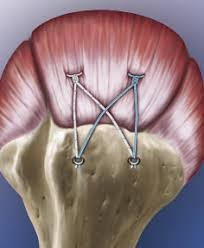
The use of a double-row suture-bridge technique guarantees very stable sutures, with a high success rate compared with standard techniques (93.6% at 5 years minimum folow-up) and faster postoperative recovery (Video 2). [5]
Video 2 Rotator cuff repair (supraspinatus tendon) with arthroscopic double-row suture-bridge technique (see text for details)
Postoperative treatment uses a brace that immobilizes the shoulder for 2-3 weeks, followed by a rehabilitation protocol to restore joint motion and muscle power with early water mobilization and hydrokinesiotherapy.
Bibliography
- Prevalence and risk factors of a rotator cuff tear in the general population. Yamamoto A, Takagishi K, Osawa T, et al. J Shoulder Elbow Surg 2010 Jan;19(1):116-20.
- Cigarette smoking increases the risk for rotator cuff tears. Baumgarten KM, Gerlach D, Galatz LM, et al. Clin Orthop Relat Res. 2010 Jun;468(6):1534-41.
- Effects of a synovial fluid substitute on early recovery after arthroscopic subacromial decompression of the shoulder. Marcheggiani Muccioli GM, Wykes P, Hundle B, et al. Musculoskelet Surg. 2015 Aug;99(2):121-6.
- The outcome and repair integrity of completely arthroscopically repaired large and massive rotator cuff tears. Galatz LM, Ball CM, Teefey SA, Middleton WD, Yamaguchi K. J Bone Joint Surg Am. Feb 2004;86-A(2):219-224.
- Minimum Five-year Outcomes and Clinical Survivorship for Arthroscopic Transosseous-equivalent Double-row Rotator Cuff Repair. Pogorzelski J, Fritz EM, Horan MP, et al. J Am Acad Orthop Surg. 2019 Dec 15;27(24):e1093-e1101.