Knee osteotomy is a refined surgical procedure aimed at correcting bone deformities and improving knee function, while also reducing pain associated with various joint conditions.

This procedure is essential for individuals suffering from conditions such as varus or valgus knee and looking for an alternative to total knee replacement.

“Osteotomy” literally means “bone cutting.” During a knee osteotomy, the tibia and/or femur are cut and realigned to redistribute the load-bearing forces within the knee joint.

The cut bone segments are then rejoined using fixation devices such as titanium plates and screws. If necessary, the resulting bone defect (in the case of opening wedge osteotomies) can be filled with allograft (donor bone) or synthetic bone graft.

Osteotomy is used as a joint-preserving procedure, either as an alternative to or a bridge before knee replacement surgery, especially in cases of knee osteoarthritis with varus (“bow-legged”) or valgus (“knock-kneed”) alignment.

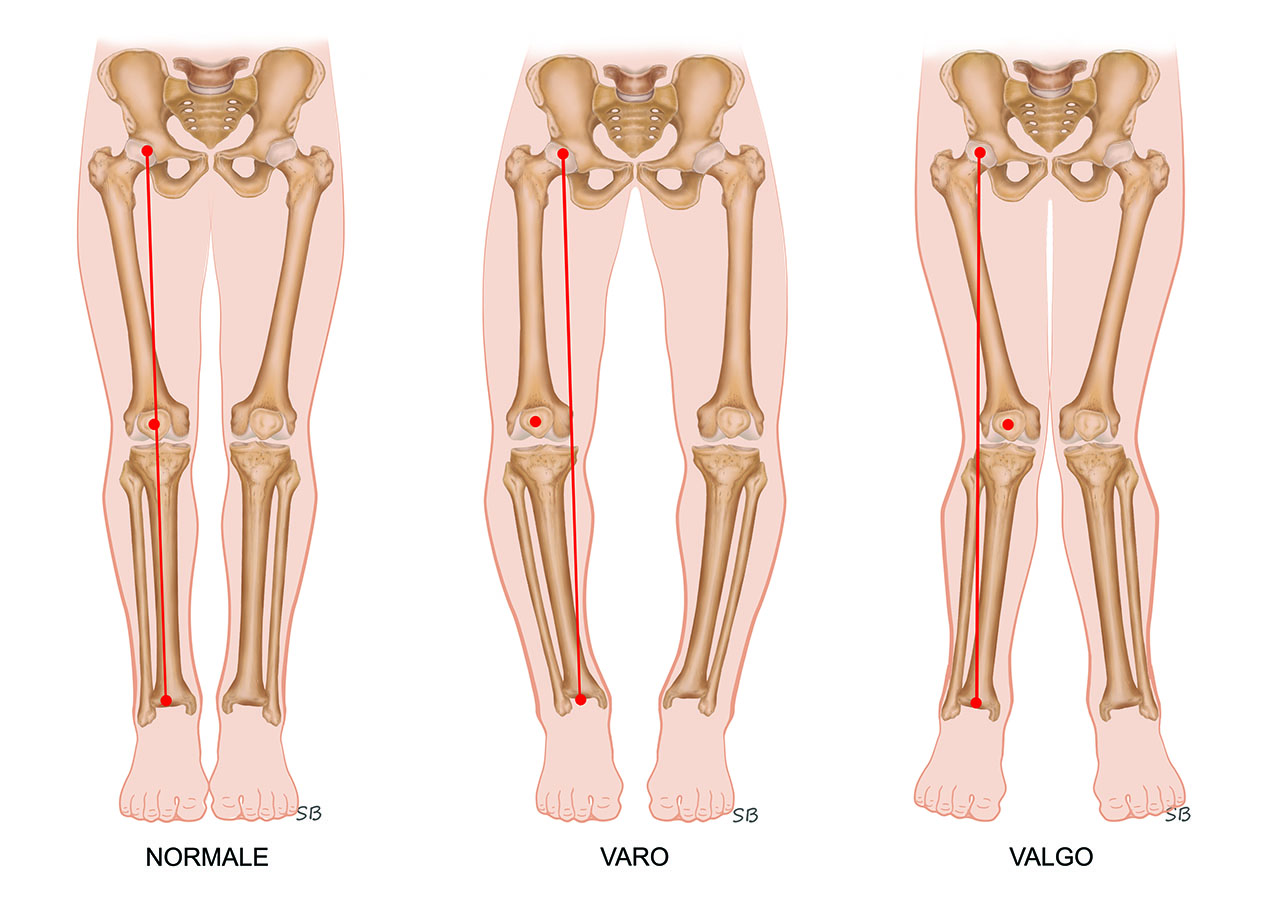
Normally, the mechanical axis of the lower limb passes through the center of the knee, allowing for an even distribution of load across the joint. In varus knees (“O”-shaped legs), the inner compartment bears excessive stress, causing progressive wear.

In valgus knees (“X”-shaped legs), the lateral compartment is more stressed and becomes damaged (Fig. 1).
Osteotomia del ginocchio
Fig. 1 Load-bearing axis of the knee. The red lines illustrate the axis (force transmission line) in a normal knee, a varus knee (“O” legs), and a valgus knee (“X” legs).

Why Is a Knee Osteotomy Performed?

Misalignments such as varus or valgus knee can cause asymmetric cartilage wear, leading to pain and limited mobility. The goal of the procedure is to restore proper limb alignment and redistribute forces across the knee joint.

We will explore this topic through the following sections:

The Different Types of Knee Osteotomies: Tibial and Femoral

  • Tibial osteotomy: Mainly performed to correct varus knees. It involves cutting and reshaping the tibia to realign the knee joint;
  • Femoral osteotomy: Less common, this is used to correct valgus knees by modifying the femur to improve alignment.

Pre-operative Process: Consultation and Diagnostic Exams

During the initial consultation, the surgeon will assess the condition of the knee, discussing expectations and possible outcomes. Full-leg weight-bearing X-rays are essential, and sometimes an MRI is required to evaluate the deformity and plan the surgery.

The Surgical Procedure

By realigning the knee and shifting the load axis from the damaged compartment to the center of the joint, pain is significantly reduced and function improved. An added advantage of this procedure is that, once healing is complete, it does not limit physical activity.

Patients can return to sports, including high-impact and contact sports like football, skiing, and basketball. [1-3] The main objective of knee osteotomy is to restore proper alignment of the lower limb and redistribute joint loads.

There are several reasons an orthopedic surgeon may recommend a knee osteotomy:

  • Unicompartmental osteoarthritis in young, active patients (under 55–60 years): Osteotomy is advised when only one knee compartment is affected (usually the medial one). The rationale is to shift the load from the diseased area to the center of the joint. Young, active patients who play sports and can handle recovery well are ideal candidates. In such cases, osteotomy is preferable to knee replacement because it allows return to contact sports (running, football, skiing);
  • Post-fracture deformities: Misalignment may result from previous fractures that healed with angular deviation. In these cases, osteotomy can restore alignment and prevent or delay osteoarthritis;
  • Osteoarthritis prevention in young patients: Used as a preventative measure in patients with high-risk deformities (varus or valgus) but no established osteoarthritis. Young patients with recurring pain and misalignment are ideal candidates. [4]

Choosing the Right Type of Knee Osteotomy

The surgeon will select the appropriate type based on the specific case, evaluating which bone is deformed and how much correction is needed. [5] Common types include:

For valgus deformities

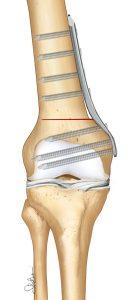
Lateral opening wedge femoral osteotomy (Fig. 2)

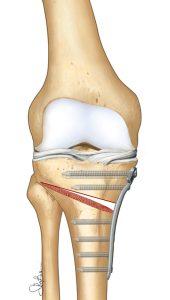
Medial closing wedge femoral osteotomy (Fig. 3)

For varus deformities

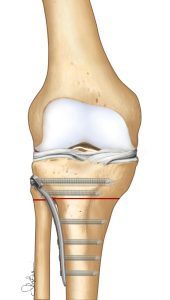
Medial opening wedge tibial osteotomy (Fig. 4)

Lateral closing wedge tibial osteotomy (Fig. 5)

osteotomia
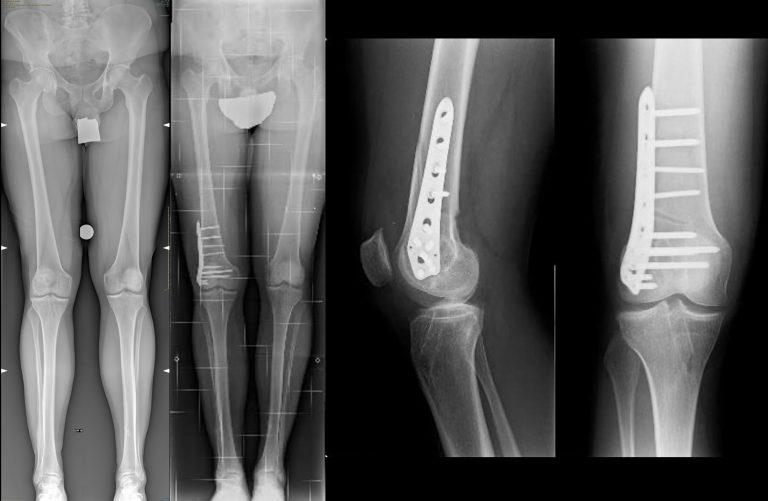
Fig. 6 Pre- and post-operative X-rays of a patient with varus knees treated with femoral varus-producing osteotomy.
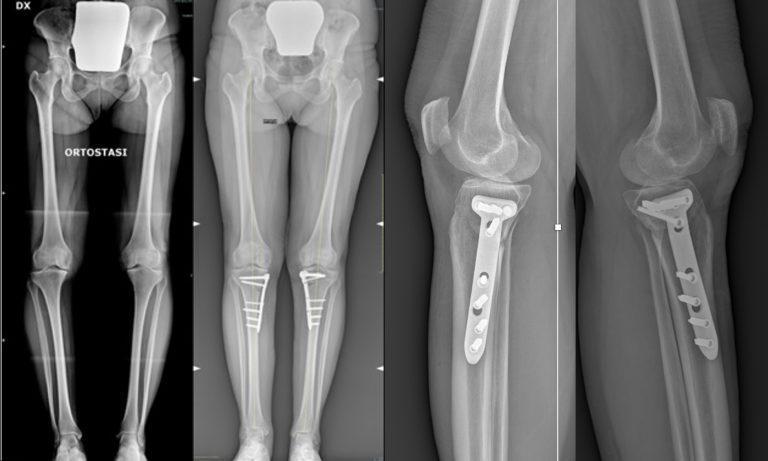
Fig. 7 Pre- and post-operative X-rays of a patient with bilateral varus knees treated with bilateral tibial valgus-producing osteotomy.

Most Frequently Performed Knee Osteotomies

The most common procedures are:

  • For valgus deformities: Lateral opening wedge femoral osteotomy;
  • For varus deformities: Medial opening wedge tibial osteotomy.

Osteotomy Combined with Other Surgical Treatments

Knee osteotomy may be combined with other procedures, such as ACL reconstruction or meniscal repair. [6] Most patients stay in the hospital for 3–4 days.

Patients typically begin exercising their knee the day after surgery with help from a physiotherapist. Sedentary work can usually be resumed after 7–10 days, while heavy labor may be possible after 2 months. [7]

Technological Innovation in Knee Osteotomy

Today, it is possible to perform custom osteotomies using 3D planning, personalized instruments, and patient-specific implants. This technology, available for the first time in Italy at our facility, makes the surgery minimally invasive.

The high degree of precision improves the long-term durability of the results (Fig. 8). [8]

Expected Results and Benefits

Improved functionality

Patients usually experience significant improvement in knee function and are able to resume daily activities. The goal is to reduce or eliminate pain caused by asymmetric cartilage wear.

Life After Knee Osteotomy

Return to daily activities

Most patients gradually return to their normal routines, following medical and physiotherapy guidelines. A healthy lifestyle and optimal body weight are crucial for preserving knee health and preventing further injury.

Knee Osteotomy: Innovations and the Future

Ongoing research is leading to less invasive techniques, faster recovery, and better outcomes. Advances in medical technology promise even greater safety and effectiveness in future osteotomies. As mentioned, for the first time in Italy, our unit offers personalized osteotomies using advanced 3D planning and custom-made tools and implants.

This technology ensures higher precision, minimal invasiveness, and longer-lasting results.

Knee Osteotomy: Prof. Marcheggiani Muccioli’s Expertise

Prof. Giulio Maria Marcheggiani Muccioli has distinguished himself in the field of orthopedics, beginning with a cum laude degree in Medicine and Surgery from the University of Bologna in 2006, followed by a cum laude specialization in Orthopedics and Traumatology at the Rizzoli Orthopedic Institute and a PhD in Surgical Sciences.

His career includes the academic role of Associate Professor of Orthopedics at the Faculty of Medicine and Surgery of the University of Bologna, where he has focused on biomechanics and pathology of the lower and upper limbs.

He expanded his expertise through international fellowships, including experiences in the UK, Japan, and the United States, establishing himself as an orthopedic surgeon with extensive practical experience, demonstrated by over 250 surgeries per year.

Prof. Marcheggiani Muccioli also plays a key role in training the next generation of physicians through university teaching across multiple medical and surgical disciplines.

He is one of only 10 Italian surgeons selected in the past 20 years by the American Knee Society to participate in the prestigious John Insall Fellowship in Knee Prosthetic Surgery. His prolific contribution to the field is reflected in over 250 scientific publications and a constant presence in academic and scientific conferences, demonstrating a deep commitment to innovation in the treatment of knee and shoulder pathologies, advancement of minimally invasive surgical techniques, and sports medicine.

Bibliography
  1. High Tibial Osteotomy: The Italian Experience. Marcacci M, Zaffagnini S,…Marcheggiani Muccioli GM, Bruni D, and Halvadjian R. Oper Tech Orthop 2007;17:22-28.
  2. Comparison between Closing-Wedge and Opening-Wedge High Tibial Osteotomy in Patients with Medial Knee Osteoarthritis: A Systematic Review and Meta-analysis. Sun H, Zhou L, Li F, and Duan J. J Knee Surg 2016 May;30(2):158–165.
  3. Osteotomy for treating knee osteoarthritis. Brouwer rw et al. Cochrane Database of Systematic Reviews, no. 12, 2014.
  4. Understanding osteotomy: a narrative review. Alesi D, Rinaldi V, Meena A, Marcheggiani Muccioli GM, Zaffagnini S. J Clin Orthop 2020 Jan-June;5(1):16-21.
  5. Combined ACL reconstruction and closing-wedge HTO for varus angulated ACL-deficient knees. Zaffagnini S, Bonanzinga T, Grassi A, Marcheggiani Muccioli GM,…, Marcacci M. Knee Surg Sports Traumatol Arthrosc. 2013 Apr;21(4):934-41.
  6. Rehabilitation Following High Tibial Osteotomy. Aalderink KJ, Shaffer M, and Amendola A. Clinics in Sports Medicine Apr 2010;29(2):291–301.

Book online